

HISTORIC PRESERVATION
Sacred sites are the physical anchors of our mission. Without preservation, the risk of deterioration or loss undermines our ability to tell the story faithfully. Our preservation work ensures that future generations engage with the legacy of Emmett Till and Mamie Till-Mobley in authentic, powerful ways.
Historical
Markers

Beginning in 2008, the Emmett Till Memorial Commission installed signs across Tallahatchie County to mark the significant places in the Emmett Till narrative, a way to publicly continue telling the story. The signs were repeatedly vandalized—stolen, shot, defaced with acid, thrown in the river. Each time, ETIC and partners replaced the signs. A bulletproof marker, the fourth sign, was installed in 2019 at Graball Landing, the site where Emmett's body was recovered and now part of the Emmett Till and Mamie Till-Mobley National Monument.
Tallahatchie County Courthouse Restoration
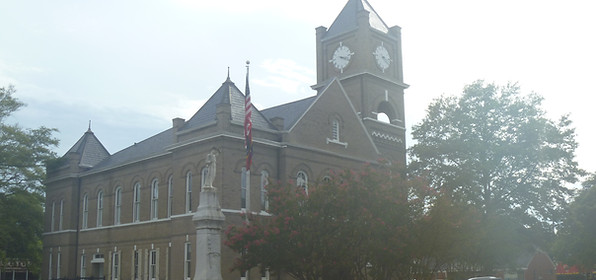
The Tallahatchie County Courthouse, site of the trial for Emmett's murder, has been a centerpiece of ETIC's work. Since our organization's beginning, staff has offered free tours of the Courthouse—which we still provide today—encouraging visitors to connect with the past. Following the 2007 community apology to the Till family on behalf of citizens of Tallahatchie County, the Emmett Till Memorial Commission set out to restore the Tallahatchie County Courthouse in order to share Emmett Till's story. The Courthouse was added to the National Register of Historic Places in 2007. The courtroom was restored in 2015, and the full building restoration was completed in 2020. The Courthouse was designated as part of the Emmett Till and Mamie Till-Mobley National Monument in 2023.
The Barn

On the morning of August 28, 1955, Emmett was abducted from his great-uncle's home and taken to a barn near Drew, MS, where he was tortured and killed. The killers admitted their guilt in a published magazine article months after the trial's conclusion. According to the article, the killing took place elsewhere, which protected others involved in the murder who had not been prosecuted. This false narrative ignored the trial testimony of Black witnesses that placed the murder at the barn.
Under ETIC's ownership, the Barn will be developed into a public memorial by 2030 as a place of learning and reflection.